
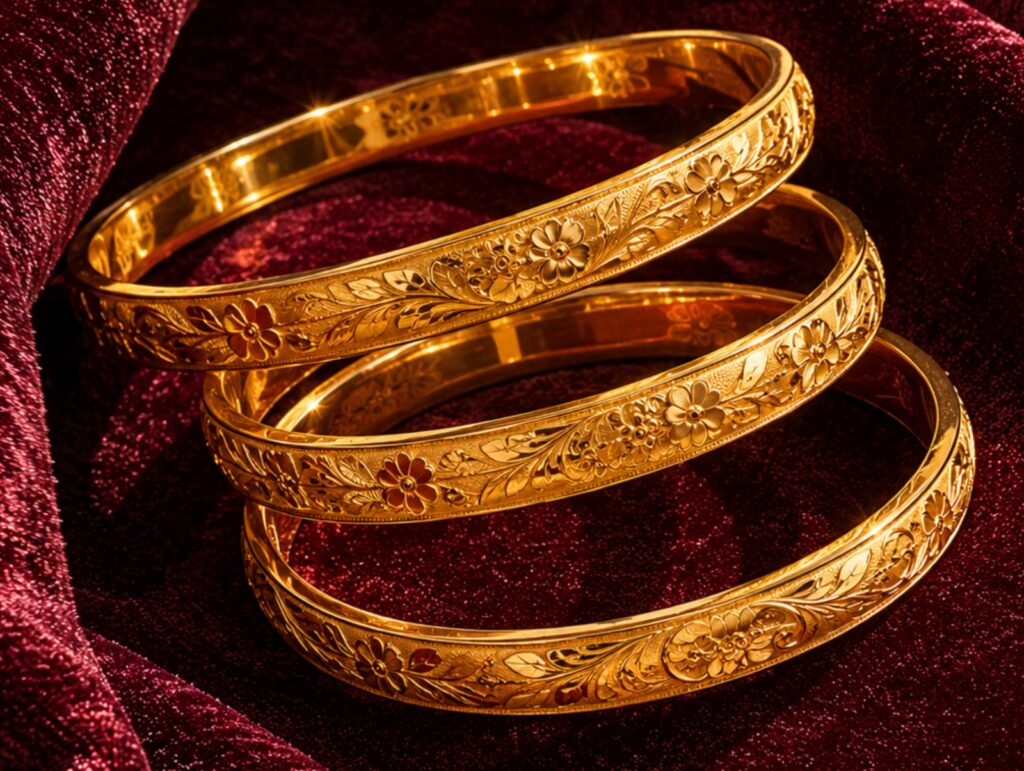
Walk into any jewellery shop in Bahrain and you will be asked a question before anything else: which karat? For buyers who have not shopped for gold before, 24K, 22K, 21K and 18K can seem like a technicality. It is not. Purity determines the price you pay, how the piece wears over years, and how much you get back if you ever exchange it.
Here is what each purity actually means and how to choose between them in the Bahrain market.
What Karat Actually Measures
Karat measures how much of an alloy is pure gold, expressed in twenty-fourths. Pure gold is 24 parts out of 24. Everything below that is gold mixed with other metals, usually copper, silver or zinc, added to give the piece strength and colour.
| Purity | Gold content | Parts per 1000 | Best suited to |
|---|---|---|---|
| 24K | 99.9% | 999 | Investment bars and coins |
| 22K | 91.6% | 916 | Traditional and bridal jewellery |
| 21K | 87.5% | 875 | Everyday Gulf-style jewellery |
| 18K | 75.0% | 750 | Diamond settings and modern designs |
A higher karat is not automatically a better purchase. It is a trade-off between purity and durability, and the right answer depends entirely on what you intend to do with the piece.
24K Gold: Purity Above All
At 99.9% gold, 24K is as pure as gold gets in practical terms. It carries the deepest, most saturated yellow colour and holds the highest metal value per gram.
It is also soft. Pure gold scratches, bends and loses shape under normal daily wear, which is why you rarely see 24K rings or bracelets meant for regular use. Its natural home is investment: bars, coins and bullion, where the metal content is the entire point and the item sits in storage rather than on a wrist.
Choose 24K if you are buying gold primarily to hold value rather than to wear.
22K Gold: The Bridal Standard
At 91.6% gold, 22K is the traditional choice for bridal and ceremonial jewellery across the Gulf and South Asia. It keeps most of the rich colour of pure gold while the small alloy content makes it durable enough to wear and to work into detailed designs.
This is the purity you will find in most heavy bridal sets, traditional necklaces, bangles and temple-style work. It also holds strong resale and exchange value, which matters in a region where jewellery is often upgraded or traded back over a lifetime.
Choose 22K if you want traditional jewellery that combines colour, value retention and heritage design.
21K Gold: The Gulf Favourite
At 87.5% gold, 21K is enormously popular across Bahrain and the wider Gulf, and it is often the sweet spot for buyers who want daily-wear jewellery without dropping too far in purity.
It is noticeably harder than 22K, so it resists denting and keeps its polish better through everyday wear. The colour is still a warm yellow, only slightly lighter. Because it uses less gold per gram, a 21K piece of the same weight costs less than its 22K equivalent, which lets buyers choose a larger or more elaborate design within the same budget.
Choose 21K if you want jewellery you will genuinely wear often and you value durability alongside good gold content.
18K Gold: Built for Stones
At 75% gold, 18K is the international standard for fine jewellery, particularly anything set with diamonds or precious gemstones.
The reason is structural. Diamond settings need prongs and claws that grip a stone securely for decades. Softer, higher-karat alloys flex over time and can loosen a stone. 18K is hard enough to hold a setting reliably, which is why almost all certified diamond jewellery and most designer pieces are made in it.
It also comes in more colours. White gold and rose gold are typically 18K, because the alloy content that creates those colours is exactly what lowers the karat.
Choose 18K if you are buying diamond or gemstone jewellery, or you prefer white and rose gold and modern design.
How Purity Affects What You Pay
Price follows gold content directly. Gold rates in Bahrain are quoted per gram at each purity, and a gram of 22K costs more than a gram of 21K, which costs more than a gram of 18K.
But metal value is only part of the invoice. Making charges, which cover design and labour, are added on top and vary by how intricate the piece is. A finely worked 18K piece can easily cost more than a plain 22K chain of the same weight. When comparing quotes, always compare the same purity, the same weight and the same design complexity, and ask for making charges to be itemised separately.
If your purchase includes diamonds or coloured stones, the certified stone value is a third element again, independent of the gold.
Always Check the Hallmark
Whatever purity you choose, the stamp is your proof. Bahrain’s Ministry of Industry and Commerce operates an official precious metals testing and hallmarking service, applying the Bahrain hallmark to both locally produced and imported jewellery.
Look for the purity mark on the piece itself, usually stamped on a clasp, an inner band or the reverse of a pendant. Ask the retailer to show you where it is. Your invoice should also record the purity and weight in writing, since that document is what you will rely on for any future exchange, valuation or insurance.
Choosing With Confidence
There is no single best purity, only the right one for the purpose:
- Buying to hold value: 24K
- Bridal and traditional pieces: 22K
- Everyday wear: 21K
- Diamonds, gemstones, white and rose gold: 18K
The easiest way to understand the difference is to see the purities side by side. At Gold City in Manama, more than 30 jewellery retailers sit under one roof, so you can compare 22K bridal work, 21K daily-wear pieces and certified 18K diamond jewellery across several brands in a single visit.
Browse the stores on our retailers page, or see our contact page for opening hours and directions. If you are new to buying gold in Bahrain, our guide to where to buy gold jewellery in Bahrain covers pricing and what to check before you pay.